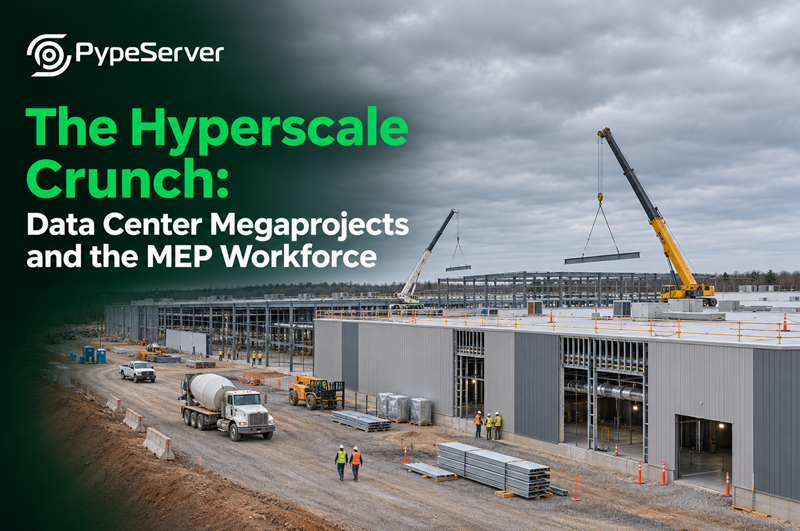
Hyperscale data center construction has become the single biggest driver of new U.S. nonresidential building, and it is drawing hardest on the trades mechanical contractors depend on: pipefitters, welders and sheet metal workers. Spending on data centers nearly doubled in a year while total construction shrank. The contractors who keep up will be the ones that move more of the work into the shop and get more output from the crews they already have.
How big is the hyperscale construction wave?
The numbers from the fall of 2026 tell a lopsided story. Private data center construction hit a record annual rate in September, even as total U.S. construction spending fell 1.9% that month. Over the past year, spending on data center construction rose about 90%, according to the Associated General Contractors of America.
| Measure | Figure | Source |
| Private data center construction, Sept 2026 (seasonally adjusted annual rate) | $96.5 billion, a series record | U.S. Census Bureau, via FourWeekMBA |
| Data centers’ share of all U.S. construction spending, Sept 2026 | 4.4% (up from 2.0% in Jan 2025) | FourWeekMBA analysis of Census tables |
| Data center construction starts, Jan–Sep 2026 | $135.8 billion across 178 projects | ConstructConnect |
| Average project | About $1.3 billion and 1.1 million sq ft | ConstructConnect |
| Median construction cost | $540.96 per sq ft, up 31% year over year | ConstructConnect |
| Data centers’ share of 2026 nonresidential building starts | 27% | ConstructConnect |
| Planned starts, next six months | $74.8 billion across 115 projects, nearly 80% in the South | ConstructConnect |
ConstructConnect’s November 2026 Data Center Report also shows where the work is landing: the South Atlantic, a Wisconsin-to-Ohio corridor and the West South Central states, led by Texas. For a regional mechanical contractor in those markets, a hyperscale campus is no longer someone else’s project. It is competing for your welders.
Why does the crunch land on the mechanical trades?
Because data centers are, at their core, power and cooling plants, and the industry was already short of the people who build them. Three data sets show the squeeze from different angles.
The overall shortage. Associated Builders and Contractors estimates the industry must attract 349,000 net new workers in 2026 and 456,000 in 2027. ENR reports that more than half of the 2026 figure is needed simply to replace retirees, and that ABC chief economist Anirban Basu sees mechanical workers trained on advanced cooling systems as a binding constraint for hyperscalers. ABC’s own rule of thumb is about 3,450 jobs per $1 billion of construction spending. Applied to an estimated $86 billion of 2026 data center spending, that is roughly 296,700 jobs, or 85% of ABC’s total projected need.
What contractors report. The AGC and NCCER 2026 Workforce Survey, released Sept 3, 2026, drew 1,830 responses:
- 28% of firms worked on a data center project in the past 12 months.
- Among those firms, 58% said data centers increased competition for skilled workers and 49% reported wage pressure.
- 37% named worker or subcontractor availability as their biggest challenge on data center work.
- Among all firms with craft openings, 88% said those positions were as hard or harder to fill than a year ago.
The pipeline of new fitters. The Bureau of Labor Statistics notes that most plumbers, pipefitters and steamfitters learn through a 4- or 5-year apprenticeship. Total employment in the occupation is projected to grow only from 504,500 in 2024 to 527,200 in 2034. A hyperscale campus breaks ground in months. You cannot apprentice your way to that timeline.
Liquid cooling raises the skill bar
AI chips are pushing past what air can cool. Operators are specifying direct-to-chip liquid cooling, which adds coolant distribution units, manifolds, leak detection and tight piping tolerances inside the data hall, according to MarketScale’s reporting on North Texas. In Dallas-Fort Worth alone, CBRE counts more than 765 MW under construction, 95% of it preleased. For the full picture of how liquid cooling changes mechanical scope, see our guide to data center liquid cooling for MEP contractors.
How are mechanical contractors keeping up with data center demand?
They are moving hours from the job site to the fab shop, where a smaller crew can produce more with less risk. Data centers suit prefabrication better than almost any building type. Pods and halls repeat across a campus and across sites, and owners want speed and predictable quality.
The industry press shows the pattern clearly. ACHR News describes chilled-water loops delivered as pre-assembled multi-pipe sections on structural racks that field crews lift and hang. The same piece notes that prefab moves overhead rigging and hot work off site, which cuts fall and struck-by exposure. Plumbing & Mechanical Engineer reports that cooling modules can be built and tested in a factory while the foundation is still being poured, so shop and site work run in parallel. MCAA even built its 2026 Fabrication Conference around data center fabrication.
Prefab only stretches a crew if the shop itself runs efficiently. Five practices separate shops that scale from shops that just get busier:
- Cut from the model, not from a printout. Every spool typed by hand into a pipe profiler or saw is a fitter’s hour spent on data entry. Model-driven cutting sends dimensioned parts straight from the design to the machine.
- Nest every cut list. At $540 per square foot construction costs, material is not a rounding error. Automated nesting and drop tracking keep large-bore pipe out of the scrap bin.
- Track every spool in real time. Hyperscale schedules are sequenced by building, hall and level. A live view of which spools are cut, welded, tested and shipped lets you sequence deliveries instead of guessing.
- Make QA documentation automatic. Mission-critical owners expect complete turnover packages. Capturing weld logs and heat-number traceability as work happens, as covered in our guide to mill test reports, saves days at closeout.
- Bid from your own data. Past production data shows what a spool, a rack or a skid really costs your shop. Our article on construction analytics for fab shops shows how to turn that history into tighter bids.
What this looks like in practice
Heritage Mechanical, a full-service HVAC, plumbing and refrigeration contractor in Crofton, Maryland, brought pipe fabrication in house for a government project with a high volume of fittings. Using PypeServer Cloud+, the shop reached full production in two weeks and saw clarification requests between design and fabrication drop 60 to 70 percent. It recovered its first-year subscription cost through material and labor savings on that project. Those gains come from the same crew: fewer questions, fewer reprints and fewer hours lost hunting for spools.
Repeatability is the hyperscale advantage
The best news for fabricators is that hyperscale work repeats. The fifth data hall on a campus looks a lot like the first. Shops that keep standard spool and rack designs in their models, and the cut data and production times that go with them, get faster on every hall. Shops that redraw and reprogram each time give that advantage away.
Frequently asked questions
It is the construction of very large data center campuses for cloud and AI operators. Projects often run to hundreds of megawatts across several identical buildings. ConstructConnect’s 2026 data puts the average U.S. data center start at about $1.3 billion and 1.1 million square feet.
ABC estimates about 3,450 jobs per $1 billion of construction spending. On roughly $86 billion of expected 2026 data center spending, that is close to 300,000 jobs, most of the industry’s projected net hiring need for the year.
Electricians and mechanical trades. Data centers are dense power and cooling systems, so they need pipefitters, welders, sheet metal workers and electricians in large numbers. Liquid cooling adds precision piping work inside the data hall.
Data halls repeat, schedules are tight and owners want consistent quality. Building pipe spools, racks and skids in a shop lets work run in parallel with site work, shrinks the field crew and moves hot work and overhead rigging off site.
Raise output per worker rather than headcount. Cut directly from the model, nest material, track spools in real time, automate QA documentation and price jobs from your own production data. These steps let a fixed crew take on more hyperscale scope.
Sources
- US Data Center Construction Hit a Record $96.5B Rate, FourWeekMBA analysis of Census C30 data released Nov 2, 2026
- Data centers kept nonresidential construction spending positive in September, Construction Dive
- November 2026 Data Center Report, ConstructConnect, Oct 30, 2026
- Data Centers, Interest Rates and More Primed to Exacerbate Labor Shortage, ABC via Construction Executive, Feb 2026
- Construction’s Labor ‘Relief’ Masks Structural Risk, ENR, Jan 2026
- Data Centers, Immigration Action Add to Construction Labor Shortage, Bisnow
- 2026 Workforce Survey national release, AGC of America and NCCER, Sept 3, 2026
- Plumbers, Pipefitters, and Steamfitters, BLS Occupational Outlook Handbook · National Employment Trends 47-2152.00, O*NET
- North Texas Data Centers Boom, Mechanical Trades Constrain, MarketScale, Nov 2026 (cites CBRE H1 2026)
- Mastering the multi-building choreography of data center campus logistics, ACHR News
- Data centers: Why prefab fits, Plumbing & Mechanical Engineer, Feb 2026
- MCAA to highlight data center fabrication during 2026 conference, Construction Owners
- PypeServer launches Cloud+ 3.0, Construction Dive press release, June 2026